
Effective practices for working with culturally and linguistically diverse children are best practices for every child. Teachers should uncover children’s culturally acquired knowledge and take their cultural backgrounds into consideration when developing the curriculum and teaching leading to positive learning outcomes for students across all age groups.
Key principles of effective practice for culturally diverse learners in the table below are congruent with several aspects of NAEYC’s position on developmentally appropriate practices:
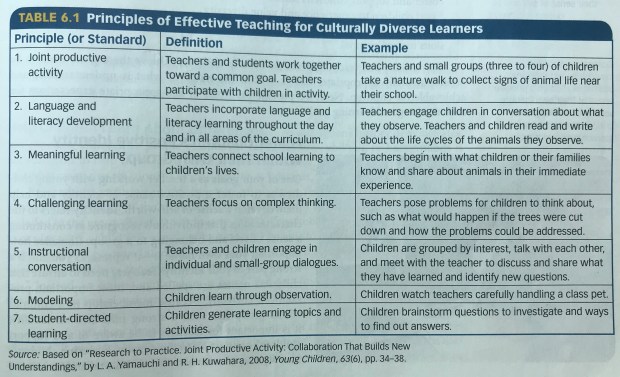
Awareness and responsiveness to diversity must be integrated across all areas of curriculum and teachers’ relationships with children. Cultural diversity is a reality that drives responsive teaching and learning.
Culturally responsive teaching is designed to achieve three goals:
- Foster and support children’s identity development within their own cultural group
- Assist children to experience and value diversity
- Foster children’s critical thinking and counter stereotypes and biases (negative expressions toward groups)
Curriculum and teaching practices to help children achieve these goals needs to be developmentally appropriate, within the range of what is understandable and achievable for children.
In helping children to understand and value diversity, teachers need to avoid the “tourist curriculum”. A tourist curriculum is one in which a culture is visited as though it were an exotic destination where people dress, talk, dance, and eat differently before returning to the “normal” place where we all live.
Here are some signs of a tourist curriculum:
- Trivializing by organizing activities around food or holidays
- Tokenism, such as having only one book about any cultural group
- Disconnecting diversity from the rest of the curriculum, such as having a one-week unit on a different culture or only discussing diversity on Martin Luther King Day
- Stereotyping groups, such as using Native American images only from the past or wearing traditional dress
- Misrepresenting groups such as using only books about Africa to each about African Americans
Developing relationships with people from diverse cultural groups and engaging in authentic experiences is the best way to help children experience and value diversity.
Cultural diversity can also be integrated throughout the curriculum. One way to help children experience and learn to value diversity is to teach overriding concepts that cut across cultural groups – we all need shelter, nourishment, friends, families, and exercise, but we meet these needs in various ways.
Building each child’s positive identity and helping them appreciate and value diversity lays the foundation for them to think critically about fair treatment of all people.

Reference:
Bredekamp, Sue (2014) Effective practices in early childhood education : building a foundation. New Jersey: Pearson Education Inc.
 Cultural Competence ToolBox