Educators who are culturally competent respect multiple cultural ways of knowing, seeing and living, celebrate the benefits of diversity and have an ability to understand and honour differences. Educators also seek to promote children’s cultural competence.
In practical terms, it is a never ending journey involving critical reflection, of learning to understand how people perceive the world and participating in different systems of shared knowledge.
Cultural competence is not static, and our level of cultural competence changes in response to new situations, experiences and relationships. The three elements of cultural competence are:
- attitudes
- skills
- knowledge
These are important at three levels:
- individual level – the knowledge, skills, values, attitudes and behaviours of individuals
- service level – management and operational frameworks and practices, expectations, including policies, procedures, vision statements and the voices of children, families and community
- the broader system level – how services relate to and respect the rest of the community, agencies, Elders, local community protocols.
While there is no checklist to tick off to identify culturally competent educators, we can start to build a picture of the attitudes, skills and knowledge required. For example, educators who respect diversity and are culturally competent:
- have an understanding of, and honour, the histories, cultures, languages, traditions, child rearing practices
- value children’s different capacities and abilities
- respect differences in families’ home lives
- recognise that diversity contributes to the richness of our society and provides a valid evidence base about ways of knowing
- demonstrate an ongoing commitment to developing their own cultural competence in a two-way process with families and communities
- promote greater understanding of Aboriginal and Torres Strait Islander ways of knowing and being
- teach, role-model and encourage cultural competence in children, recognising that this is crucial to ensuring children have a sense of strong cultural identity and belonging
- engage in ongoing reflection relating to their cultural competence and how they build children’s cultural competence.

Ongoing reflection essential for the learning journey
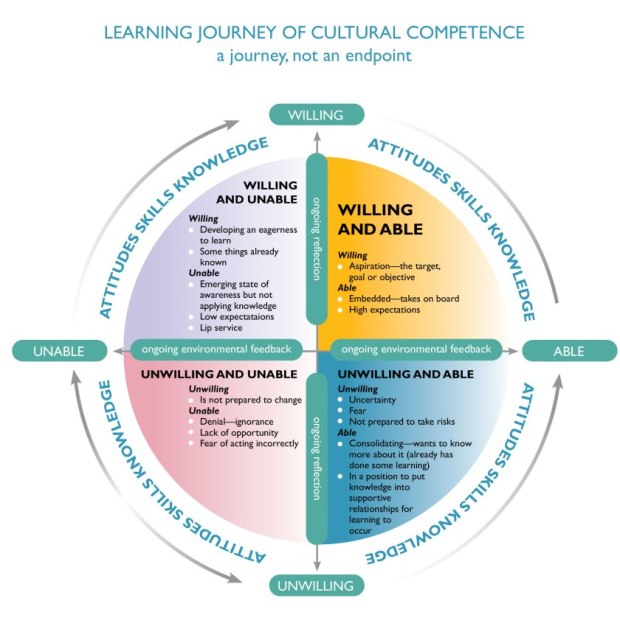
A learning journey of cultural competence occurs when ongoing reflection and environmental feedback involves and supports educators to move along their culturally competent learning journey. The following diagram from the Educators’ Guide to the Early Years Learning Framework (p26) is a useful tool to share with educational teams, to discuss and to identify how individuals are progressing on their learning journey.
There are also many reflective questions in the Guide and Learning Frameworks to provoke discussion and reflection. For example:
- Who is advantaged when I work in this way? Who is disadvantaged?
- What does cultural competence mean in your practice, for children, family, community and educators?
- What do you know about the language/s that the children bring with them?
Reference: https://wehearyou.acecqa.gov.au/2014/07/10/what-does-it-mean-to-be-culturally-competent/
 Cultural Competence ToolBox